04 — Circles
Reframing a Web3 currency as a reward you can actually spend.

Overview
Circles launched as an ambitious Web3 currency; a universal basic income where users mint 1 CRC per hour and value derives from trust graphs and affiliate groups. Beautiful ideology. In practice, users were overwhelmed and adoption was low.
The business wanted adoption and engagement. Users wanted to know what this is, why they should care, and what they can do with it now. Trust graphs and affiliate groups are great for a whitepaper, not for an onboarding experience.
The work was to reframe Circles from alternative monetary system to reward currency without changing the protocol. Same mechanics, simpler story.
Before
€100 before you knew what this was.
The original onboarding asked users to back the currency with €100 through a full-screen CTA. Backing is a real protocol mechanic (it strengthens CRC value and signals long-term conviction) but it was the first thing users saw, before they understood what Circles is or what CRC could do for them. A commitment screen masquerading as a welcome screen.

Before
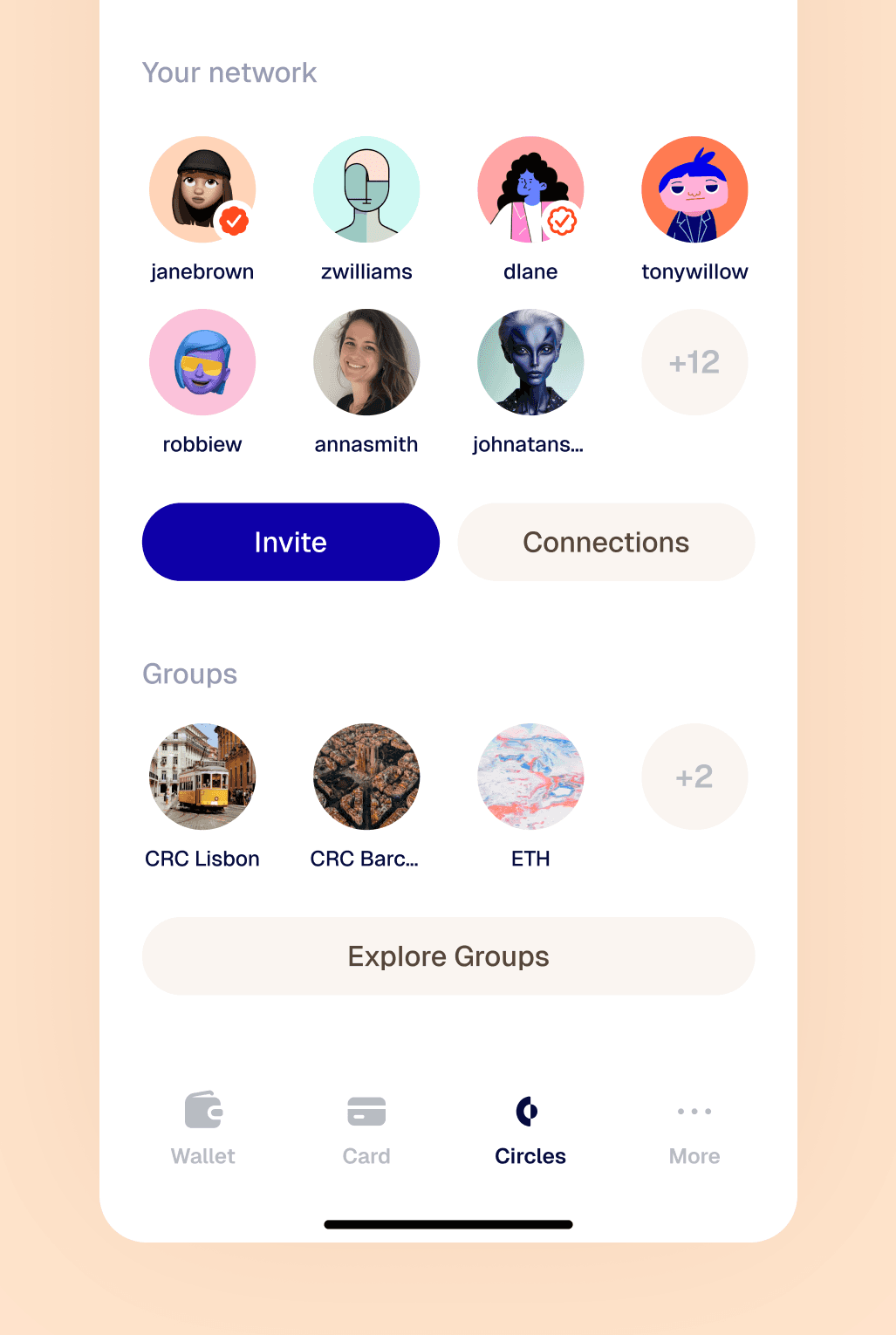
Three protocol mechanics, zero scaffolding.
Groups, affiliate groups, and the trust network were surfaced as primary UI from day one. Groups had no join button, because membership was automatic, gated by each group's own criteria, which left users unsure why they were or weren't in one. An affiliate group is a specific thing: the single group a user supports by paying it 2 CRC daily, in return for that group strengthening their CRC's value. Trust networks demanded effort with no payoff in sight, because users still didn't know what CRC was for.
The reframe in one screen
Same protocol. Different first impression.
Before: an onboarding deck teaching users that "money can be created by people, not banks." Beautiful, but a lot to ask on first open. After: a balance and a marketplace deal. The economic thesis becomes a discoverable depth, not a barrier to entry.

Marketplace
Make the value tangible from day one.
The marketplace turns CRC from abstract token into something users recognize. Subscriptions, flights, gift cards, real brands priced in CRC. The visual language deliberately echoes familiar neobank reward patterns so users immediately know how to read the screen.
Progressive depth
Do more with Circles
when you're ready.
Trust, Groups, and Backing, the mechanics that make Circles different from a regular point system, moved into a "Do more with Circles" carousel. Users who care about the protocol can opt in. Users who just want rewards never have to learn it.
Key Design Decisions

Earn-spend-redeem, not 'alternative money'
Reframed the protocol's surface using a pattern users already know from neobanks. Same mechanics, new mental model.

Aha moment in six seconds
Ideology ≠ UX. Start with utility, reveal depth later. Show the loop before you explain the thesis.

Familiar marketplace patterns
Subscriptions, flights, gift cards priced in CRC, styled like banking rewards. Abstract token becomes something users recognize.

Protocol depth as opt-in
Trust, Groups, and Backing moved into a discoverable "Do more with Circles" carousel. Believers still get the system; beginners never have to learn it.
Strategic Decisions
01 · The signal
The lack of utility was bothering me for months.
Users were dropping off in onboarding before they understood the core mechanic. The "alternative money" framing demanded a paragraph of explanation before any value showed up. New users were being asked to learn an economic thesis, not use a product.
02 · How I framed it
A user problem, not a feature request.
I didn't put anything on the roadmap. That's not my role. I framed the observation: users don't have a reason to come back. The whitepaper explains what Circles is, the product doesn't tell them what to do with it. Then I let leadership decide whether to act on it.
03 · How it cascaded
Head of Growth escalated, leadership decided.
The Head of Growth picked up the signal and escalated it into the strategic conversation. From there I can only assume leadership evaluated it against the broader vision. I wasn't part of those roadmap conversations. My job was to make the user problem visible, not to negotiate priorities.
04 · The reframe
From "alternative money" to "reward currency".
Most neobanks already use a familiar pattern: spend, earn, redeem. Users instantly understand it. Circles' advantage is that we didn't need a separate point system: CRC is native. I shifted the UX to one sentence: earn CRC for free, spend it on marketplace deals. Same protocol, new language.
05 · What stayed protected
The protocol didn't change. Only the surface did.
Trust, groups, and backing; the deeper mechanics that make Circles different are still fully there. They moved into a "Do more with Circles" carousel that users discover when they show intent. Beginners get a reward currency. Believers still get the alternative monetary system. Nobody had to give anything up.
Outcomes & Learnings
01
Clear, familiar value: "free rewards you can actually spend." Lower cognitive load, more users reaching the marketplace.
02
Business goals preserved without breaking the vision. Activation and marketplace usage went up. The protocol stayed intact.
03
Key learning: ideology ≠ UX. Start with utility, reveal depth later. The best framing wins more users than the best feature.